ETL Solutions for Fleet Tracking Systems: Optimize Your Data Workflows
Managing a modern fleet involves more than just tracking vehicle locations. GPS logs, fuel consumption, driver behavior, maintenance schedules, and IoT sensor data all generate massive amounts of information daily. Without a proper strategy, these data streams remain siloed and underutilized. This is where ETL solutions for fleet tracking systems come into play.
Why Fleet Tracking Systems Need ETL Solutions
Fleet operations rely on continuous streams of telematics and IoT data from GPS trackers, ELDs, fuel sensors, and more. Without proper data integration, managers struggle with incomplete reports and delayed decision-making.
- Combine real-time GPS and telematics data into a single source of truth.
- Standardize inconsistent formats from multiple tracking providers.
- Automate data delivery into dashboards, CRMs, and ERP systems.
- Enable AI-assisted analytics to detect anomalies and optimize operations.
- Ensure compliance with reporting requirements and auditability.
Why Choose a Self-Hosted ETL Tool?
Fleet tracking data is highly sensitive - covering driver behavior, customer locations, and operational efficiency. Cloud-only ETL tools often introduce unnecessary risks and ongoing subscription costs.
Meet Advanced ETL Processor
Advanced ETL Processor is a powerful, self-hosted data integration platform that simplifies complex transformations and automates data flows for fleet tracking systems. It’s designed for IT teams that need reliability, flexibility, and scalability without the lock-in of cloud services.
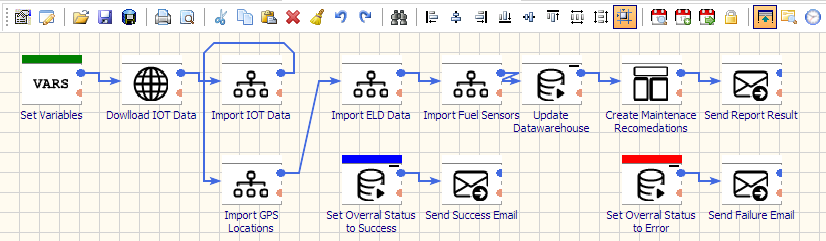
- Data automation: Schedule ETL jobs to collect GPS data, fuel logs, and sensor readings automatically.
- Unified data pipeline: Integrate data from multiple tracking providers, IoT sensors, and ERP systems.
- Data quality control: Validate coordinates, timestamps, and status codes to avoid corrupted reports.
- AI-powered analytics: Leverage AI for predictive maintenance, route optimization, and anomaly detection.
- Error handling & logging: Built-in monitoring ensures transparency and faster troubleshooting.
- Flexible connectivity: Works with databases, APIs, flat files, and real-time data streams.
- Vehicle performance monitoring: Aggregate mileage, fuel usage, and engine diagnostics.
- Driver behavior analytics: Combine GPS, braking, and acceleration data for safety insights.
- Route optimization: Use AI to suggest cost-effective routes based on historical traffic and delivery times.
- Predictive maintenance: Automate alerts based on mileage, usage patterns, and sensor data.
- Regulatory compliance: Prepare auditable reports for ELD and DOT compliance automatically.
How AI Improves Fleet Data Integration
AI can significantly enhance fleet tracking systems when combined with a robust ETL solution. With Advanced ETL Processor, you can run AI-assisted models directly on your infrastructure - ensuring data privacy and compliance while gaining predictive insights.
Getting Started in 3 Steps
- Install & connect: Deploy Advanced ETL Processor on your server and connect it to GPS devices, IoT sensors, and telematics APIs.
- Build transformations: Map fields like vehicle IDs, coordinates, and fuel levels, then clean and validate incoming data.
- Automate & monitor: Schedule workflows, set alerts, and track real-time ETL performance via built-in dashboards.
Business usage examples
Operations lead
Coordinate multi-source logistics data in one scheduled ETL workflow.
Planning analyst
Track fulfillment, delays, and stock metrics from validated inputs.
Platform owner
Monitor runs, retries, and handoffs across distributed systems.
Video walkthrough
Stop struggling with fragile ETL scripts. Start shipping reliable workflows.
Download the fully functional 30-day trial. Build your first automation in 10 minutes or less.
Direct link, no registration required.