QVD vs QVX
Use QVD when you want the fastest native reloads inside Qlik, and use QVX when you need an open exchange format for connectors, external generation, or distributed ETL workflows. If your file strategy is getting out of column, this is usually the fix.
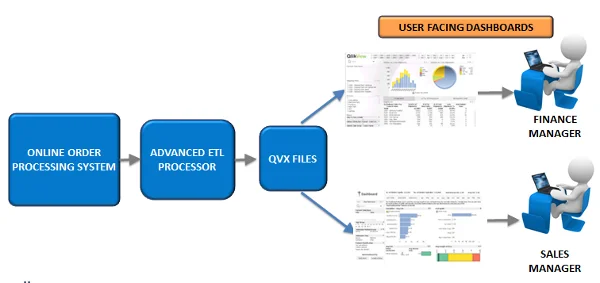
QVD vs QVX in one clear comparison
Both formats move data into Qlik environments, but they are designed for different jobs.
Advanced ETL Processor can process both QVD and QVX, so you can keep one workflow tool even when your projects use both formats.
- QVD: proprietary Qlik format, optimized for minimum transformation and fast native loading.
- QVX: public Qlik data exchange format with metadata + data payload, designed for connector and integration scenarios.
This matches how Qlik describes QVX in its developer docs and connector SDK documentation (QlikView developer docs, Qlik Sense developer docs).
When QVD is the better choice
Choose QVD when your pipeline lives mainly inside Qlik and you care about reload performance. In most cases, it is the simplest approach for reusable intermediate data sets across apps.
If you are building a straightforward in-platform workflow, you may not need anything else. Sometimes the right answer is boring, and boring ETL is usually the stable kind.
When QVX is the better choice
Choose QVX when data is produced outside Qlik, when you need custom connectors, or when you want transformation and validation before Qlik loads the file.
Practical view: teams often overpay for shiny cloud ETL stacks when a predictable self-hosted workflow would do the job. If the requirement is reliable file exchange, QVX plus a practical ETL process is often enough.
Using Advanced ETL Processor Enterprise, you can build QVX-ready workflows with validation, scheduling, and file delivery in one place. You can also compare this with approaches in our posts on Parquet for warehousing, directory monitoring, and cloud storage automation.
A practical decision rule
- If data is generated and consumed mostly within Qlik, start with QVD.
- If data comes from external systems or custom connectors, start with QVX.
- Validate sample files first, then schedule production jobs.
- Keep raw source files untouched for troubleshooting and audit.
If you only need a one-off small load, you might not need our software at all. A quick manual import can be enough. But if this runs every day, automate it before your 7:00 a.m. coffee turns into incident response.
FAQ
Can Advanced ETL Processor process both QVD and QVX?
Yes. Advanced ETL Processor can process both QVD and QVX, which is useful when one workflow needs to handle native Qlik files and exchange-format files together.
Is QVD faster than QVX in Qlik reloads?
Usually yes. QVD is optimized for native Qlik loading with minimal transformation inside the platform.
Is QVX proprietary?
No. QVX is a public format intended for exchange and connector scenarios.
Can I generate QVX outside Qlik?
Yes. That is one of its main use cases, especially for custom connectors and external ETL workflows.
When should I avoid both and keep it simple?
If your use case is a one-time, low-volume import, manual loading may be perfectly fine.